

5 Steps to Measure Your Dog for a Harness
Last Updated: October 26, 2026
Quick Summary
To measure dog harness size, wrap a soft fabric tape around the widest part of the chest, just behind the front legs, keeping the tape level and snug enough to slide one finger underneath. Write down that chest girth number and match it to the product's size chart, not your dog's breed or weight.
- You need a soft fabric tape, a helper and small treats before measuring.
- Measure a standing dog, since a sitting dog can read an inch or more smaller.
- No fabric tape? Use string, mark where the ends meet and lay it flat against a ruler.
- If your girth number sits near the top of a chart range, size up.
- A harness should fit snug with room for two fingers under every strap.
Table of Contents
- Before You Start: What You Need to Measure a Dog for a Harness
- How to Measure Dog Chest Girth Behind the Front Legs
- Measuring Neck and Head Circumference for Harness Styles
- Reading a Dog Harness Size Chart and Choosing a Size
- How Should a Dog Harness Fit? Fit Checks After Sizing
- What to Do If a Dog Is Between Harness Sizes
- Frequently Asked Questions
Before You Start: What You Need to Measure a Dog for a Harness
Most measure dog harness sizing mistakes happen before the tape touches the dog. A wriggling dog, a sagging tape, and a distracted handler produce numbers you can't trust, and those numbers become a harness that rubs.
Before you learn how to measure dog for harness sizing, set yourself up properly.
Tools for Taking Dog Measurements
You need three things, and none of them are complicated:
- A soft fabric measuring tape. The flexible kind tailors use. A stiff metal tape from the garage will not follow the curve of a chest.
- A helper. One person holds the dog, one person measures. Solo measuring works, but expect to redo it.
- Small treats. Reward a calm stand. This keeps the dog still without a wrestling match.
How to Measure Dog Chest Girth Behind the Front Legs
Chest girth is the key number when you measure dog harness sizing. Get it right and you're most of the way home, but no single tape placement works for every build, and that's where most sizing goes wrong.
Here's the base sequence, then how to adapt it to your dog's shape:
- Have your helper stand the dog on a flat surface in a natural stance.
- Find the widest part of the chest, just behind the front legs.
- Wrap the soft tape around the body at that point, circling the rib cage.
- Keep the tape level, not angled up toward the neck or down toward the belly.
- Snug the tape against the fur without compressing it. You should be able to slide one finger underneath.
- Read the number where the tape overlaps and write it down.
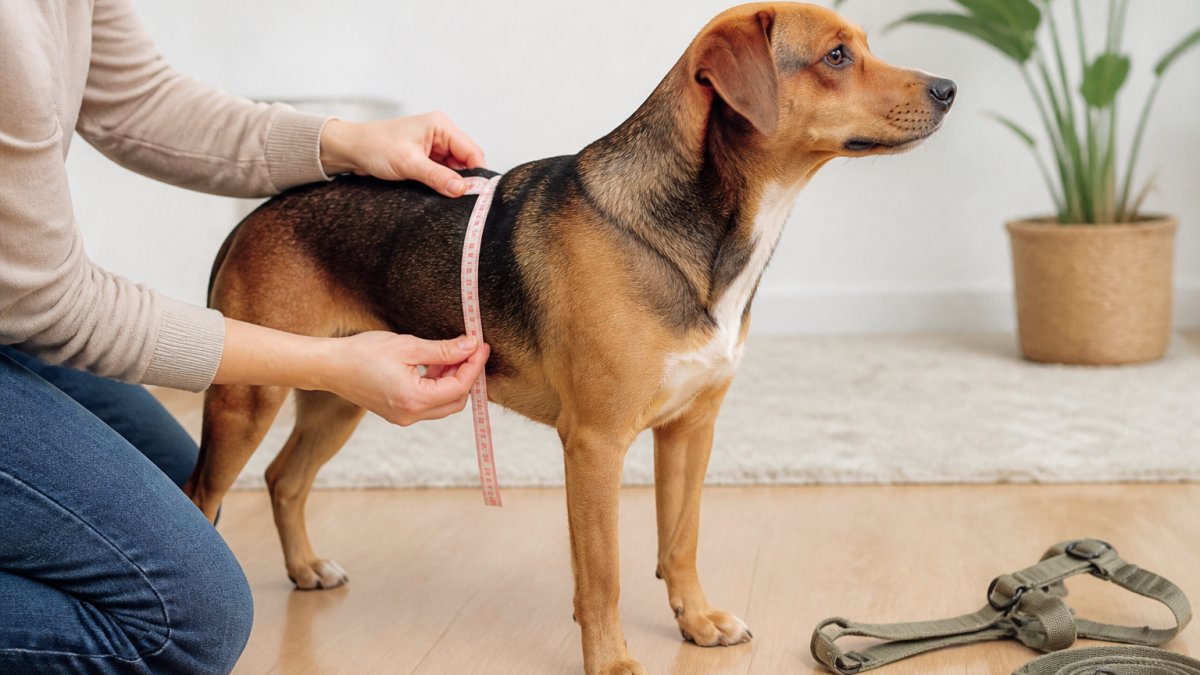
Finding the Widest Part of the Chest
The widest point sits right behind the shoulder blades, where the rib cage is deepest.
A common mistake is measuring too far back, near the belly. That gives you a smaller number and a harness that pinches at the armpit.
Long-bodied and deep-chested breeds can have a chest noticeably wider than the neck. That's normal, trust the tape, not your eye.
Adjusting Tape Placement for Different Body Shapes
The six-step sequence is the default, but the tape must follow the dog's actual contour. Adjust like this:
- Deep-chested dogs (chest drops well below the elbows): The widest point often sits farther back than you expect, because the rib cage flares before it tapers. Measure at the deepest part of the rib cage, not the shoulder, and keep the tape level, on a deep chest it's easy to let it dip under the belly, inflating the number.
- Broad or barrel-chested dogs: The chest can be nearly as wide as it is deep. Wrap the tape flat against the sides rather than riding up over the shoulder blades; a twisted tape reads short. Measure twice and compare.
- Small dogs (under about 15 pounds): A standard tailor's tape can be wider than the space behind the front legs, so it bridges the armpit instead of hugging the body. Use a narrower tape or string, and measure where the chest is widest, often very close to the front legs.
Measuring Without a Fabric Tape
No fabric tape? Use string or a shoelace. Wrap it around the widest part of the chest, mark where the ends meet, then lay it flat against a ruler. Do it twice, because string stretches and fingers slip.
When to Remeasure
Chest girth isn't permanent. Puppies, dogs on a weight-loss plan, and dogs building muscle can change girth within weeks. Remeasure every few weeks during growth or weight change, and keep a written record so you spot the shift before the harness rubs.
Measuring Neck and Head Circumference for Harness Styles
Not every harness needs a neck measurement, but step-in and overhead styles do. Here's how to take both.
Neck circumference: Measure around the base of the neck, where a collar naturally sits.
Head circumference: Measure around the widest part of the skull, just in front of the ears and under the jaw.
A front-clip harness usually relies on chest girth alone; back-clip or step-in designs may ask for neck and head numbers too.
Reading a Dog Harness Size Chart and Choosing a Size
A dog harness size chart maps your measurements to a size. Read it carefully, because charts are not universal.
- Match your chest girth number to the chart's range, not to your dog's breed or weight.
- If your number falls inside a range, that size is a candidate.
- If your number sits near the top of a range, size up.
Once you have your numbers, you're ready to look at the harness itself. You can view the Aesthetic Dog harness to see how its sizing applies to a real design, no hardware to adjust, a single seamless piece that loops around the body.
How Should a Dog Harness Fit? Fit Checks After Sizing
A harness should fit snug but not tight, with room for two fingers under every strap and no gaping at the chest. Now the checks.
- Two-finger test: Slide two fingers under the chest strap. They should pass with slight resistance. If they slide freely, the harness is loose. If they won't fit, it's too tight.
- Leg openings: Watch the dog walk. The leg openings should not rub the armpit or restrict the front legs.
- Strap adjustment: Check that straps sit flat and even on both sides.
If the harness shifts or rubs, adjust the straps before you assume the size is wrong. Watch the video below to learn how to use the harness and see it fitted and adjusted on a real dog: How to Use.
What to Do If a Dog Is Between Harness Sizes
Between sizes is normal. The fix depends on the dog, the harness design, and how close the number sits to the edge of the range. Work through these in order.
Step 1: Check Where the Number Falls in the Range
A size chart gives a range, not a single number. Mid-range girth is usually the right starting point. Within about an inch of the top, size up; within about an inch of the bottom, size down. The exact margin depends on the chart, so read the manufacturer's guidance rather than assuming a universal rule.
Step 2: Match the Harness Style to the Measurement
Different designs use different numbers, which changes how you handle a borderline reading:
- Front-clip and back-clip harnesses usually size on chest girth alone. A borderline girth reading is the only variable, so use the range rule above.
- Step-in harnesses may also ask for neck circumference. If girth and neck disagree, follow girth for the body and check the neck opening clears the head.
- Overhead or strap-over-the-head designs may ask for head circumference. A wide skull with a narrow chest can land in two sizes; choose the size that fits the chest and confirm the head opening passes over.
Step 3: Account for Coat and Growth
- Size up if the dog is still growing, has a thick or double coat, or sits at the very top of a range. Fur compresses under a tape but not under a strap.
- Size down if the dog is fully grown, lean, and sits at the bottom of a range.
- Choose an adjustable design when the numbers land mid-range, so straps can take up the slack. A harness with several adjustment points handles a borderline measurement better than a fixed-size design.
Step 4: Use the Product's Own Size Chart
A size chart is specific to the product, not to dogs in general. Match your chest girth number to that chart's range, not your dog's breed or weight. Ignore breed labels, two dogs of the same breed can measure very differently. If the chart lists both girth and weight, use girth as primary and weight only as a cross-check.
Step 5: Remeasure as the Dog Changes
Puppies and dogs losing or gaining weight need remeasuring every few weeks, a harness that fit in spring may rub by summer. Recheck chest girth monthly during growth spurts or weight change, and keep a written record so you spot the shift. When a dog crosses into the next range, treat it as a new sizing decision rather than adjusting the old harness past its limit.
Measure twice, buy once.
When a measurement lands between sizes, work through these steps in order.
| Step | What to do | Key detail |
|---|---|---|
| 1 | Check where the number falls in the range | Within about an inch of the top, size up |
| 2 | Match the harness style to the measurement | Front-clip and back-clip size on chest girth alone |
| 3 | Account for coat and growth | Size up for growing dogs or thick coats |
| 4 | Use the product's own size chart | Use girth as primary, weight as cross-check |
| 5 | Remeasure as the dog changes | Recheck chest girth monthly during growth or weight change |
Frequently Asked Questions
How do you measure a dog for a harness if you don't have a fabric tape?
Use a piece of string, ribbon, or a phone charging cable. Wrap it around the widest part of the chest behind the front legs, mark where the ends meet with your fingers or a pen, then lay the string flat against a ruler or yardstick. Take the chest girth twice to confirm the number. A flexible tape gives a cleaner reading, but string works fine as long as it lies flat and isn't stretched.
How tight should a dog harness fit?
You should be able to slide two fingers under every strap, including the chest strap and the neck opening. The harness should feel snug but not tight, with no gaping at the shoulders and no rubbing at the armpit. Watch your dog walk, sit, and turn: the leg openings shouldn't dig in, and the straps shouldn't shift sideways. If the harness leaves marks or your dog freezes on the leash, loosen it one notch.
What size harness does a 15-pound dog wear?
Weight alone won't tell you the size. A 15-pound dog can have a chest girth anywhere from roughly 14 to 20 inches depending on breed and body shape, which can land in small or medium on most size charts. Measure the chest girth behind the front legs and match that number to the chart, not the weight. If the measurement falls between two sizes, size up and tighten the straps.
How often should I remeasure my dog for a harness?
Remeasure every two to three months for puppies and every six months for adult dogs, plus any time the harness starts sitting differently. Puppies can add chest girth quickly during growth spurts, and adult dogs shift shape with weight changes, age, or a thick winter coat. A quick chest girth check takes under a minute and prevents a harness from becoming too tight or too loose.
Sizing a dog for a harness takes five minutes and one soft tape, but the payoff lasts every walk. A harness that fits well sits quietly, moves with the dog, and never needs a mid-walk adjustment. That's the standard we build to at Aesthetic Dog: gear that's beautiful by design and quiet by intention, with no hardware to rattle and nothing to distract from the walk. Get started with Aesthetic Dog and give your dog a harness that fits as well as it looks.
